
1. Habits help people act without thinking.
2. Rituals help people connect behaviours to identity, emotion and belonging.
3. Understanding the difference can transform how organisations approach behaviour change.
1. Habits help people act without thinking.
2. Rituals help people connect behaviours to identity, emotion and belonging.
3. Understanding the difference can transform how organisations approach behaviour change.

Turning a one-off action into an enduring, repeat behaviour is the goal for many organisations. There are two paths to consider for repeat behaviours: are we trying to create a habit, or a ritual?
Habits and rituals may both involve repetition, but they go about it in different ways.
Some behaviours need to become easier, faster and more automatic. Others need to become more meaningful, emotionally resonant, and worth protecting. Both habits and rituals involve repetition. Both can be triggered by cues. Both can be reinforced over time. But they play different roles in people’s lives, and that matters for how organisations design change.
A habit is useful because it reduces cognitive load. It helps us act without having to consciously decide every time. We brush our teeth, tap our card, put the seatbelt on, sort the recycling, check an app, take medication, or pay a bill. When habits work well, they often become invisible.
For organisations, this makes habits powerful when the desired behaviour is frequent, functional, or low emotion. If the behaviour is something people need to do regularly but do not particularly want to think about, the job is to reduce friction. Make it easy. Make it timely. Make it fit into an existing routine. Make the next step obvious.
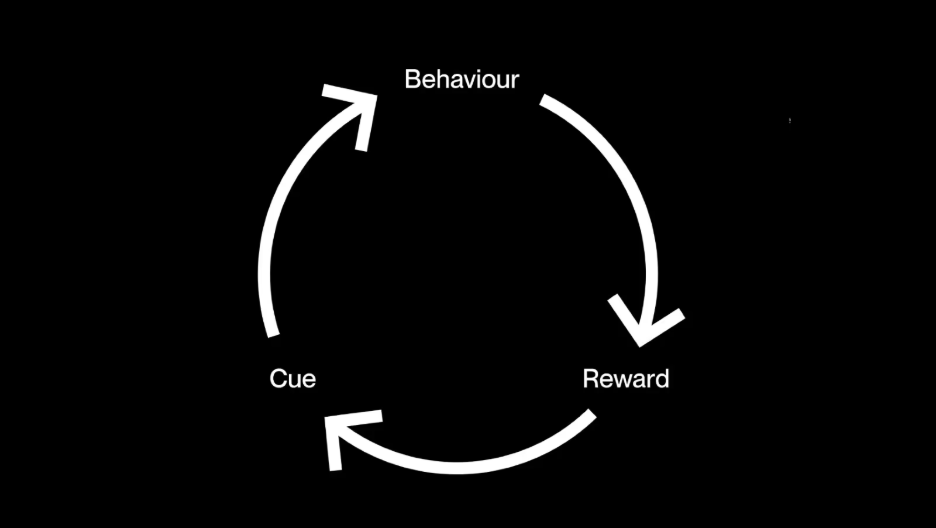
This is where TRA’s work on habits is useful. The habit loop (cue, behaviour, reward) gives organisations a practical way to think about how repeated behaviours form. The cue prompts the behaviour. The behaviour is made easy enough to complete. The reward reinforces it and helps set up the next repetition.
This matters for public sector challenges like paying fines on time, attending appointments, renewing registrations, taking medication or completing forms correctly. It also matters commercially for behaviours like using a banking feature, returning packaging, checking account balances, booking a service, or remembering to reorder a product.
In these cases, success is often quiet. They need the behaviour to feel simple, expected and low effort. If people have to stop, interpret, decide, and motivate themselves every time, the design is probably doing too much.
Rituals are repeated behaviours too, but they carry meaning. They are more conscious, more emotional and more connected to identity, relationships, culture or a sense of self. They are not only about what people do. They are about what the moment represents.
Walking home with music or a favourite podcast can become protected “me time”, a way to decompress and move from one part of the day into another. Friday night drinks with the same group of friends can become a marker of belonging, continuity and shared history. A favourite family meal at the local beach each month can hold memory, connection and a sense of who we are.
These behaviours are not powerful because they are frictionless. They are powerful because they matter.
This is where emotions become central. Rituals often help people feel grounded, connected, comforted, or in control. They can mark transitions, reinforce identity, create belonging, or help people manage uncertainty. Our work on rituals shows that they are not simply repeated behaviours; they are intentional, meaning bearing and often emotionally or socially anchored.
That means they cannot be treated like habits with a better soundtrack.
For organisations, rituals are relevant when the behaviour change challenge involves identity, emotion, connection or commitment. Think about wellbeing behaviours, saving towards a meaningful goal, preparing for a major life transition, participating in civic life, building community connection, or creating shared moments around family, sport, food, culture or spirituality.
A health organisation might design a medication habit by making reminders timely and packaging easy to use. But if the challenge is helping someone feel hopeful, supported and in control during recovery, a ritual may be more powerful: a weekly reflection, a visible marker of progress, a shared check-in, or a moment that helps someone recognise how far they have come.
A financial services brand might build a habit around automatic savings. But if the challenge is helping people feel more confident about their future, there may be value in creating a monthly money reset: a moment to review progress, name priorities and connect financial behaviour to the life someone is trying to build.
A public sector organisation might make voting easier through reminders, clear instructions and accessible polling places. But voting can also be understood as a civic ritual: a visible act of participation, identity and belonging. Designing only for ease risks is missing the meaning that makes the behaviour feel worth doing.
The strategic question is not whether habits or rituals are better. It is whether the behaviour needs to become more automatic, or more meaningful.
Design for habits when the challenge is friction.
Design for rituals when the challenge is significance.
If the behaviour is administrative, repetitive, low-interest or easily avoided, habit design may be the right approach. Reduce the steps. Strengthen the cue. Make the reward immediate. Consider ‘piggybacking’ by connecting it to an existing routine.
If the behaviour is emotional, identity-led, shared with others or symbolic, ritual design may be more effective. Understand what the moment means. Protect what people value about it. Support the emotional role it already plays.
This distinction is especially important for organisations and brands. Many organisations want to become part of people’s routines, but not every routine is an open invitation.
Some moments are functional and can be made easier. Others are meaningful and need to be handled with care.
The opportunity is to know the difference.
Habits solve for efficiency. Rituals solve significance.
The strongest behaviour change strategies recognise when people need less to think about, and when they need more to feel.






.jpg)


_11zon.jpg)
%20(1)_11zon.jpg)



.jpg)

.jpg)
edited.jpeg)