
We hear it constantly: the future is uncertain. But repetition doesn’t make it less true – if anything, it risks making us numb to the scale of what people are experiencing socially, economically and culturally.
Add to that the growing instability of democracies and the fracturing faith in institutions that once provided a sense of continuity and support. What does this cultural context do to us? Our line of sight pulls closer. We focus on what matters in the time and space we can control.
Ritual plays a huge role in interrupting that numbness.
Rituals interrupt the routine of everyday life, pulling us briefly out of autopilot and reconnecting us to emotion, connection and shared experience. Rituals that bring us together, like sport or a concert, seem frivolous in the scheme of things. But if COVID taught us anything, it was that they are more important than we realised.
For brands, these shifts matter because rituals increasingly shape how people connect, consume and create meaning in everyday life.
In our latest Rituals study across Australia and Aotearoa New Zealand, people repeatedly described rituals as moments of control, comfort and connection within increasingly uncertain lives. What emerged across the research was not a desire for bigger experiences, but a deeper attachment to smaller repeated moments that helped life feel emotionally and socially anchored.
Humans are creatures of repetition. Much of our lives are shaped by behaviours we barely think about at all. The route we take to work. The coffee made the same way every morning. Brushing our teeth before bed. These habits help reduce cognitive load and create efficiency in our day. But rituals are different. Rituals carry emotional weight. They hold meaning beyond the act itself. A habit helps us function, but a ritual helps us feel.
The word ‘ritual’ can give a sense of stability. However, just like anything in life, it requires effort and time to ensure it endures. When we skip or lose an established ritual, we lose those markers of time that can remind us of how we’re moving through time together. When asked to describe the loss of collective rituals, people reflected on the drift of both intimate routines, like family meals and holidays, and larger shared moments like ANZAC or memorial commemorations.
What people described was not necessarily the loss of the event itself, but the loss of what those rituals represented – connection, synchronisation and shared emotional experience. Losses that quietly add up over time in ways only noticeable upon reflection.
In many ways, people reflected less on the ritual itself and more on what disappeared when it was disrupted. The emotional texture around it. The sense of rhythm. The feeling of moving through time alongside other people.
When we describe ‘culture’ at The Research Agency (TRA), we define it by the meaning we share. That could be as significant as a gathering of friends and family at a funeral or as simple as making small talk on a Monday at work after the weekend. If culture is the meaning we share, rituals are the practice of making meaning. They create moments of collective attention and participation that help people feel connected to something bigger than themselves.
What emerged across the study was a growing sense that shared moments are becoming rarer. Rituals increasingly stand out because they create synchronisation in a culture that otherwise feels fragmented, personalised and always-on.
As the media landscape changes, we lose moments of synchronicity, so anything that brings us together in ritual has a staying power that will endure through these times. In marketing, attention is gold – but the same ingredient is essential in taking part in rituals. Our collective attention. The drift from free-to-air TV to streaming changed how and when we watched shows. Rather than discussing what was ‘on’ last night, we are now navigating whether we share the same interests, the same streaming subscriptions, or even the same cultural reference points at all.
The water cooler moment was a ritual that defined the modern worker – now it’s slowly been displaced.
Even the rise of activities like run clubs points to a broader cultural shift. On the surface they appear fitness-oriented, but culturally they function as rituals of connection, accountability and belonging in a time where many traditional forms of community have weakened. The resurgence of analogue experiences more broadly, from pottery classes to book clubs to shared dining experiences, speaks to a growing appetite for rituals that feel embodied, collective and emotionally grounding.
While rituals are fragile and can be disrupted, they also function as a form of personal infrastructure during periods of instability. Many rituals operate as quiet acts of self-repair, helping people manage anxiety, stress, exhaustion or emotional overwhelm in places where larger systems often fall short.
In our study, many of the rituals people described functioned as forms of emotional regulation and recovery, particularly in response to stress, uncertainty and exhaustion.
Practices like yoga, meditation, therapy routines, social dance, running clubs or even shared meals become more than wellness behaviours. They become stabilising rituals that help people regulate themselves emotionally and physically within an increasingly unstable and fast-changing world.
Rituals reveal that consumer behaviour is often driven as much by emotion, identity and belonging as it is by utility and convenience. For brands, this matters because rituals are not simply moments where attention is captured – they are moments where meaning is reinforced. Rituals are emotionally and socially meaningful spaces that people feel a sense of ownership over because they help structure identity, connection and everyday life. The brands that become part of rituals are often absorbed into something much deeper than consumption itself.
They become associated with comfort, recovery, belonging, reward, transition or togetherness. Not because they demanded attention successfully, but because they became culturally relevant within the rhythm of the ritual itself. Which also means brands cannot simply force their way in. Rituals are protective by nature.
To earn a place within them, brands need to understand the emotional and cultural role the ritual is already performing in people’s lives. This is especially important for brands trying to maintain relevance in the unpredictable and often chaotic cultural conditions we find ourselves in.
In uncertain times, rituals become less about tradition for tradition’s sake and more about creating continuity within instability. They help people make sense of change, reconnect to others, and preserve a feeling of shared meaning within increasingly fragmented systems. Far from frivolous, rituals may be some of the most important cultural infrastructure we have.
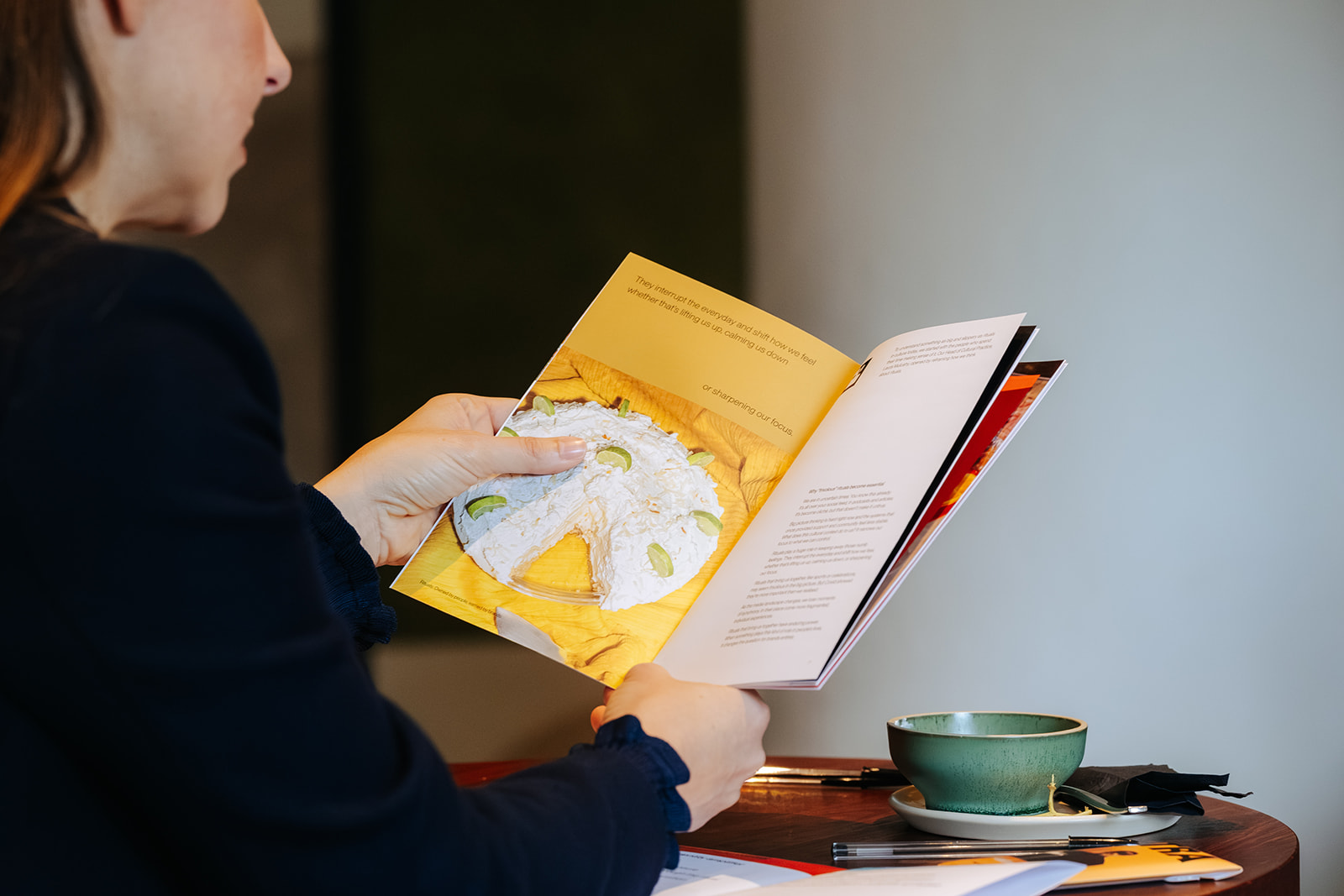
Our latest study explores the cultural shifts and consumer behaviours shaping modern rituals across Australia and New Zealand, and how people are using them to navigate uncertainty, connection and modern life.
Explore our findings on what rituals mean to people and how brands can earn a place. Read the full report here.





.jpg)


_11zon.jpg)

%20(1)_11zon.jpg)


.jpg)

.jpg)
edited.jpeg)