

Humans are creatures of habit. Much of daily life runs on repeated behaviours that happen with very little conscious thought, like brushing your teeth, checking your phone while the kettle boils, or taking the same route to work each morning. These behaviours reduce effort and create familiarity in everyday life.
But some repeated behaviours carry more meaning than simple routine. While habits are often automatic and functional, rituals tend to carry emotional weight, identity and intention.
To be considered and chosen, brands need to come to mind at the right moments.
There is clear evidence that brands grow by being easy to think of across a wide range of buying situations. These situations arise when people experience different triggers or cues, known as Category Entry Points, or CEPs, which lead them towards a purchase decision.
CEPs can be as simple as feeling hungry, needing a quick solution, or looking for a way to switch off at the end of the day. For marketers, they offer a practical way to understand how demand emerges in the real world and where brands can earn relevance.
But not all CEPs are created equal.
The Research Agency’s (TRA) latest study, Rituals, involving more than 2,000 people across Australia and Aotearoa New Zealand, suggests that many rituals can also function as CEPs, creating opportunities for brands to play a meaningful role.
Some CEPs are fleeting. They appear in response to a need, are resolved quickly, and leave little trace behind. Others repeat, are more deliberate, and carry much more emotional meaning. These CEPs can become ritualised moments that are less about what is being done and more about the emotional payoff people get from repeating it.
Brands have permission to take part in people’s rituals, but only in specific ways. According to TRA’s study, 59% of Australians are open to brands when they show up consistently, 55% when they personalise the experience, and 53% when they make the moment easier. Similar patterns show up for New Zealanders.
Take a morning meditation as an example. On the surface, someone doing 30 minutes of meditation each morning is taking part in a personal ritual. But if they are looking to enhance their experience, that ritual can also become a category entry point for brands – an opportunity for a meditation app, herbal tea, a candle, journal, mat, playlist, or supplement to support that moment.
In this sense, the ritual becomes the CEP. The need is no longer just to meditate, but also to support the experience around it.
When a CEP becomes ritualised, it has the potential to become far more powerful than it first appears. These moments are more intentional, carry more emotional weight, and often play a meaningful role in people’s lives.
This creates an opportunity for brands. The task is not only to map CEPs, but to identify which ones are worth building stronger links into – where the brand can show up consistently, add value, and become part of how that ritual is experienced.
An example of a brand seizing this opportunity is NZ Post. Sending gifts to loved ones for Mother's Day, Father's Day and Christmas represents a ritualised CEP that carries significant emotional meaning for many people.
For Christmas in particular, NZ Post responded with their award-winning Send from Home this Christmas campaign, which focused on the emotional and sentimental value of sending a parcel overseas. NZ Post enhanced the ritual by communicating the emotional benefit of sending a gift and making international gift-giving easier through clear communication and a curated gift wish-list.
Rituals are owned by people. Brands seldom create rituals on their own. They earn a place within them over time by showing how they can enhance these moments. When that boundary is respected, brands can become part of something that feels natural and enduring. When it is ignored, the result often feels forced and is quickly rejected.
For generations, people have gone out with friends, family or colleagues for a pre-dinner drink. For many, this has become a ritualised moment that carries intention, meaning and emotion. Enter Aperol Spritz – a drink built around this ritualised CEP. Since acquiring Aperol in the early 2000s, Campari Group has worked to make Aperol Spritz part of this occasion globally. Aperol did not create the pre-dinner drink ritual, but it earned its way in through consistency.
For a ritual to matter from a brand perspective, it needs to occur frequently enough, and across enough people, to create scale. The opportunity sits where repetition, meaning, and scale intersect – moments that are both commercially valuable and emotionally significant.
This has implications for how we measure brand performance. Traditional brand tracking focuses on brand funnel metrics such as spontaneous awareness, prompted awareness, and consideration. These remain important, but do not fully capture whether a brand is present in memory at key category entry points, including ritualised CEPs.
Within TRA’s approach to brand tracking, this opens a more precise lens. Tracking can be used to understand which CEPs matter most, which are consistently linked with a brand or its competitors, and whether those connections are strengthening or weakening over time.
When beginning CEP tracking, a foundation study is often used to identify the moments that show up most frequently in people’s lives, and where the greatest commercial opportunity may sit. But it is also useful to distinguish between functional CEPs and ritualised CEPs. Functional CEPs can help drive reach and choice. Ritualised CEPs can do this too, while also strengthening how people feel about the brand over time.
Brand tracking that includes CEP measurement helps identify the category entry points that matter most to growth. By understanding where the brand is already strong, and where there is an opportunity to build stronger associations, tracking becomes more than a measure of performance. It becomes a way to identify where future growth is most likely to come from.
The focus moves from inserting a brand into a ritual, to understanding how it already exists and where a brand can add value. It becomes less about capturing attention in isolation, and more about participating in patterns that are already established.
For brands, this changes the task. It is no longer enough to identify when a CEP is triggered. The challenge becomes understanding what that moment represents in a person's life. When it carries emotional or identity-based meaning, the expectations placed on the brand increase.
Brands need to align with what is already happening, rather than attempting to redirect it. They need to reduce effort, not introduce it. They need to feel consistent, not constantly new.
Ritualised CEPs signal something more stable. Marketing systems are often built around bursts of activity, designed to capture attention and create impact in short windows. Rituals operate through repetition, stability, and the reliability of showing up in the same way over time. Brands that embed themselves in these spaces tend to feel familiar rather than attention-seeking, becoming part of the background in a way that strengthens their presence.
In a landscape where attention is fragmented and effort feels high, the brands that succeed are often the ones that reduce the need to choose at all. They become familiar, reliable, and easy to return to. They become part of the rhythm people rely on.
This raises a more deliberate question. Not just where does our brand show up, but also which moments are worth earning a place within?
Curious about the rituals shaping people’s lives, and the role brands can meaningfully play within them?
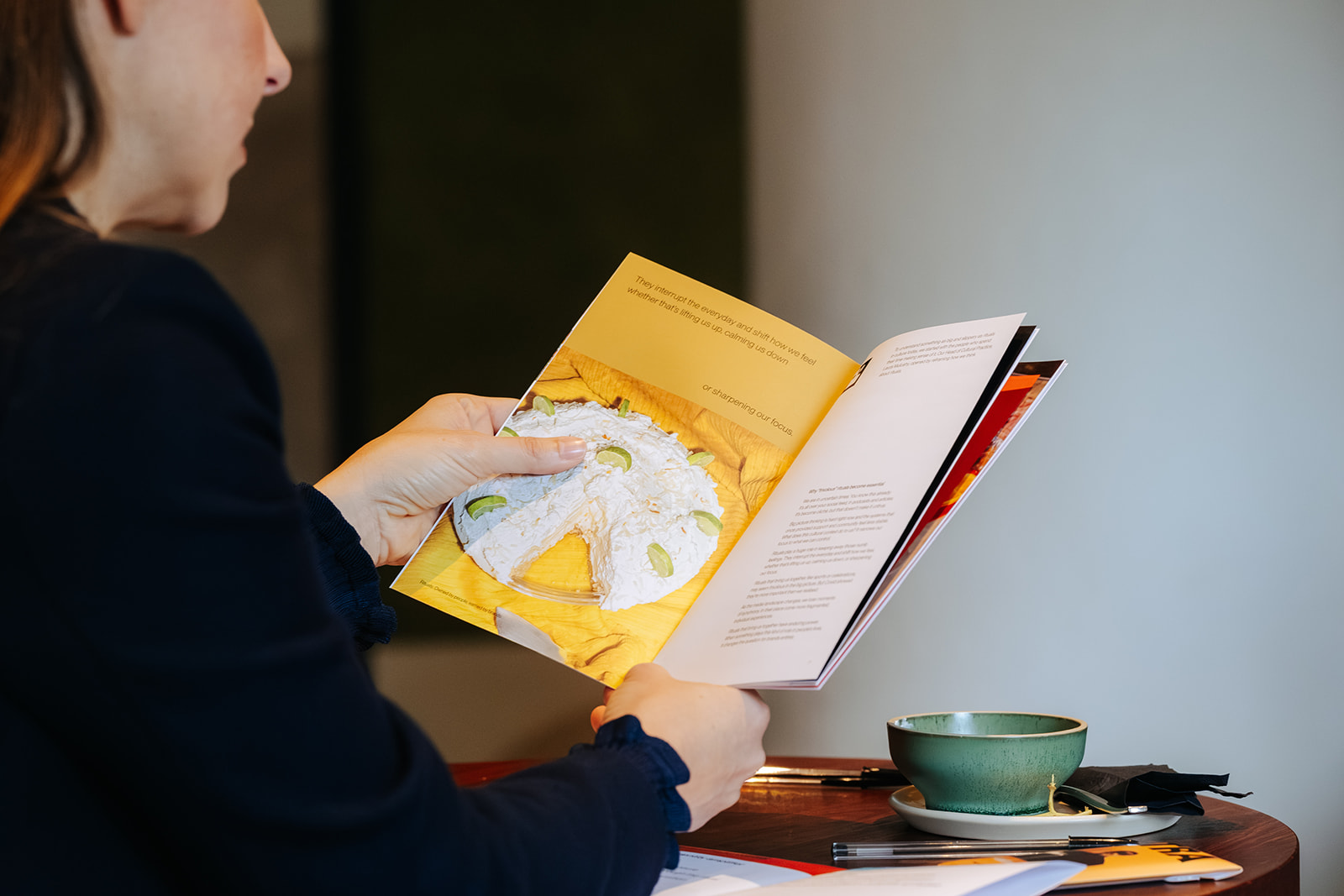
Download the full Rituals report or read more on why rituals matter now. If this has sparked a question, challenge, or opportunity for a brand, get in touch here.

.png)




.jpg)


_11zon.jpg)

%20(1)_11zon.jpg)


.jpg)

.jpg)
edited.jpeg)