
1. Culture doesn't define motivation. Aussie Minds reveals that Australian-born and overseas-born Australians share broadly similar motivational MindSets.
2. There is diversity within diversity. People with shared cultural or migration experiences can have very different values, aspirations and motivations.
3. Brands need to look beyond demographics. Combining cultural understanding with motivational insights helps brands connect with audiences in more relevant and meaningful ways.
1. Culture doesn't define motivation. Aussie Minds reveals that Australian-born and overseas-born Australians share broadly similar motivational MindSets.
2. There is diversity within diversity. People with shared cultural or migration experiences can have very different values, aspirations and motivations.
3. Brands need to look beyond demographics. Combining cultural understanding with motivational insights helps brands connect with audiences in more relevant and meaningful ways.

What can cultural background tell us about what motivates people? And where do our assumptions about shared experiences fall short? Shasha Gan, Qualitative Lead at The Research Agency (TRA), draws on her own experience as a first-generation New Zealander and her work in Diversity, Equity and Inclusion to examine what Aussie Minds reveals about culture, migration and the motivations shaping Australians’ choices.
I’ve been thinking about the relationship between culture and motivation for a while. Partly because of my own experience as a first-generation New Zealander, and partly through my work on Diversity, Equity and Inclusionat TRA.
You often hear about new migrants bringing a kind of “hustler” energy – starting again, navigating a new environment and building something from scratch. But does that mean they come to Australia with a fundamentally different set of values or motivations from people born in Australia?
I saw this in my own family. My parents both had to hustle when they moved countries, but that shared experience didn’t mean they were motivated by the same things. My dad was much more driven by getting ahead and what might be possible next; for my mum, a good life was more about stability, security and creating a comfortable home for our family.
That distinction has always interested me. When someone moves to a new country, are we seeing fundamentally different motivations – or familiar human motivations playing out in a different cultural and life context?
In 2023, I worked on TRA’s Kiwi Codes research and, later, a deeper exploration of first- and second-generation migrants in New Zealand. That work sparked an ongoing question for me: how much can cultural background really tell us about what people value, trust and respond to?
More recently, I’ve been exploring that question through Aussie Minds, TRA’s framework for understanding the different motivational MindSets shaping Australians’ choices. Aussie Minds gave me another way to think about how cultural background relates to how people see and respond to the world.
As Colleen Ryan explained, the opportunity with Aussie Minds is not to replace demographics, but to understand what sits beneath them. That principle becomes particularly important when the demographic in question is culture or migration background.
Cultural background can tell us a lot about someone’s context and experience. But where does its explanatory power stop? How much can it really tell us about what someone values, trusts or responds to?
When we explored the Aussie Minds data, we wondered whether overseas-born Australians might be more likely to fall into certain MindSets. Would the experience of moving countries be associated with stronger motivations around ambition, progress or change?
But the results challenged that assumption.
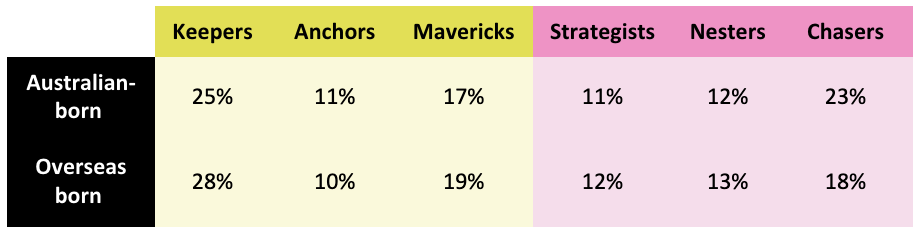
Overseas-born and Australian-born Australians were distributed across the six MindSets in broadly similar ways. There were some differences, but no single MindSet dominated the overseas-born group. There was no “migrant-specific” Aussie Mind.
In other words, being born overseas didn't point us towards one particular way of thinking, feeling or making decisions.
That's an important finding. Because while migration can be a defining life experience, it doesn't necessarily tell us what someone is striving for or what they value most.
Two people can both have moved to Australia in pursuit of a “better life” and mean very different things by “better.”
For a Chaser, getting ahead is about progress, possibility, freedom and momentum. For a Nester, aspiration is expressed differently: greater stability, comfort, security and room to breathe.
Both might be ambitious. Both might have made significant sacrifices to build a life in Australia. But what they're working towards, and what they need to feel they're getting there, can look very different.
Consider how a financial services brand might speak to these two people. One may respond to opportunities for growth and getting ahead, while the other may place greater value on reassurance, security and feeling in control.
A shared migration experience doesn't necessarily translate into a shared idea of success.
That's where diversity within diversity becomes important. Even within groups that share significant life experiences, there can be very different motivations shaping how people make decisions.
Of course, that doesn’t mean culture or migration experience is irrelevant. Far from it.
Cultural background can shape how people experience the world – the languages they use, how they access information, the expectations they bring, what feels familiar, the barriers they encounter, and the cues that help them feel understood or included.
But for brands and organisations, the risk is treating those cultural markers as a shortcut to understanding motivation.
Consider a campaign targeting overseas-born Australians. Cultural understanding can help a brand communicate in ways that feel relevant, respectful and accessible. But it doesn't automatically tell the brand which message will resonate most.
Is the audience looking for reassurance and security? Are they motivated by progress and possibility? Or are they looking for simplicity and greater control over their lives?
Those motivations can exist across cultural backgrounds, just as different motivations can exist within the same cultural community.
This creates an opportunity for brands to think about both dimensions:
One doesn't replace the other. Together, they offer a more complete understanding of the people brands are trying to reach.
Because cultural understanding can help us connect with people in ways that feel relevant to their lives. Understanding motivation helps us go further, towards what actually matters to them.
Culture can tell us something important about someone's experience. But it can't tell us everything about what makes them tick.
And for brands trying to understand an increasingly diverse Australia, knowing the difference matters.
Explore the Aussie Minds research.

.png)






.jpg)



_11zon.jpg)

%20(1)_11zon.jpg)


.jpg)

.jpg)
edited.jpeg)